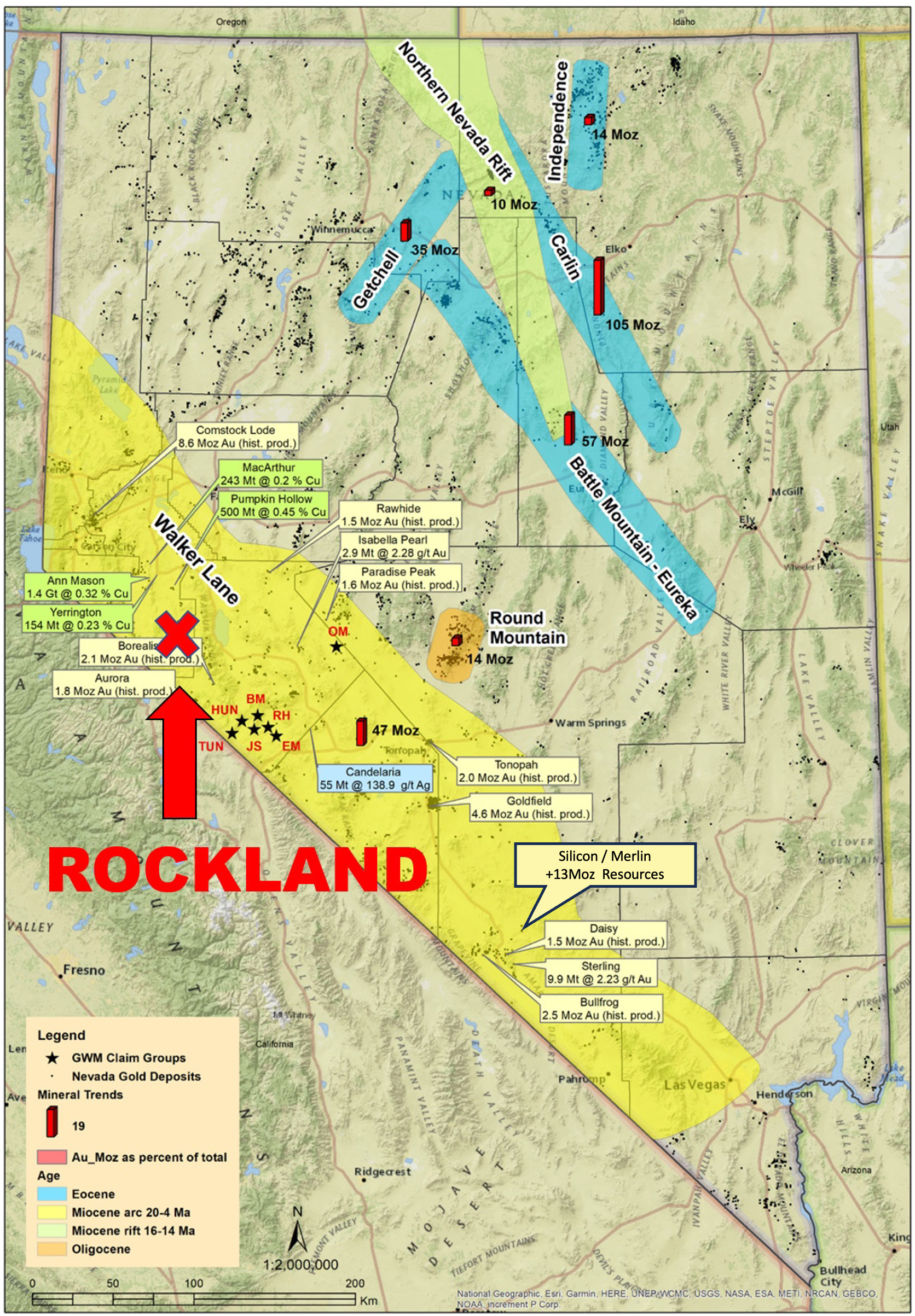
The company can earn up to a 75% interest in the property that is located in the Walker Lane Trend of Nevada. The company completed a 1,600 metre drill program in Q4 2025 and confirmed the presence of both wide low grade and narrower high grade structures at depth in altered rhyolites. The focus is to continue drilling at depth and along string to extend the positive results announced to date that includes 40.9 m at 1.92 g/t AuEq within 100.0 m at 1.1 g/t AuEq below historical drill results that included 146.4 metres at 1.0 g/t AuEq in hole PG-32 and 42.7 metres at 1.7 g/t AuEq in hole PG-36C. Several bonanza-type gold targets occur within the large Rockland East hydrothermal system. An analogous target model is AngloGold’s major new Silicon-Merlin discovery located in the Bullfrog District further to the southeast along the Walker Lane trend, which hosts Indicated-level mineral resources of 121 mT for 3.4 million ounces of gold and Inferred mineral resources of 391 mT for 12.9 million ounces of gold.
Property highlights
Average grades
10
Zn
4
Pb
1.5
Cu
100
Ag plus Au
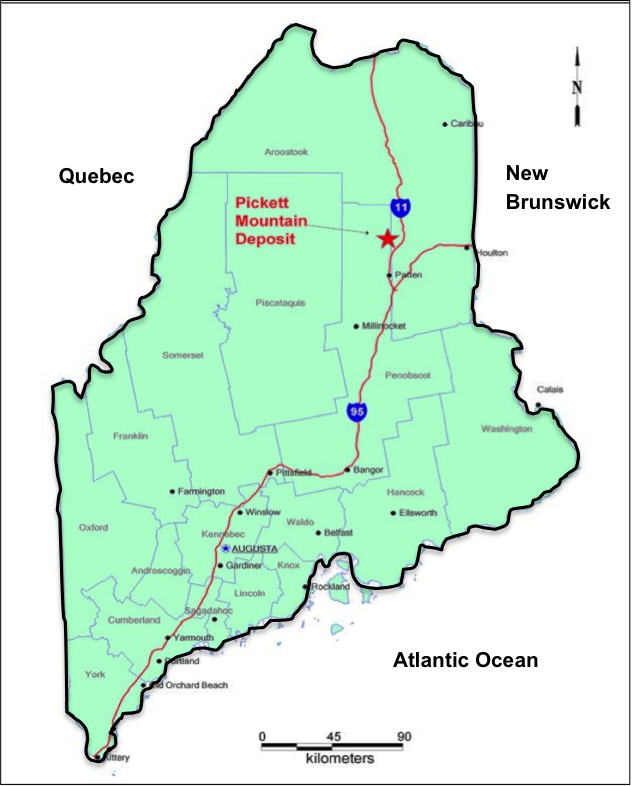
Location map, Nevada U.S.A.
(Click image for larger view)
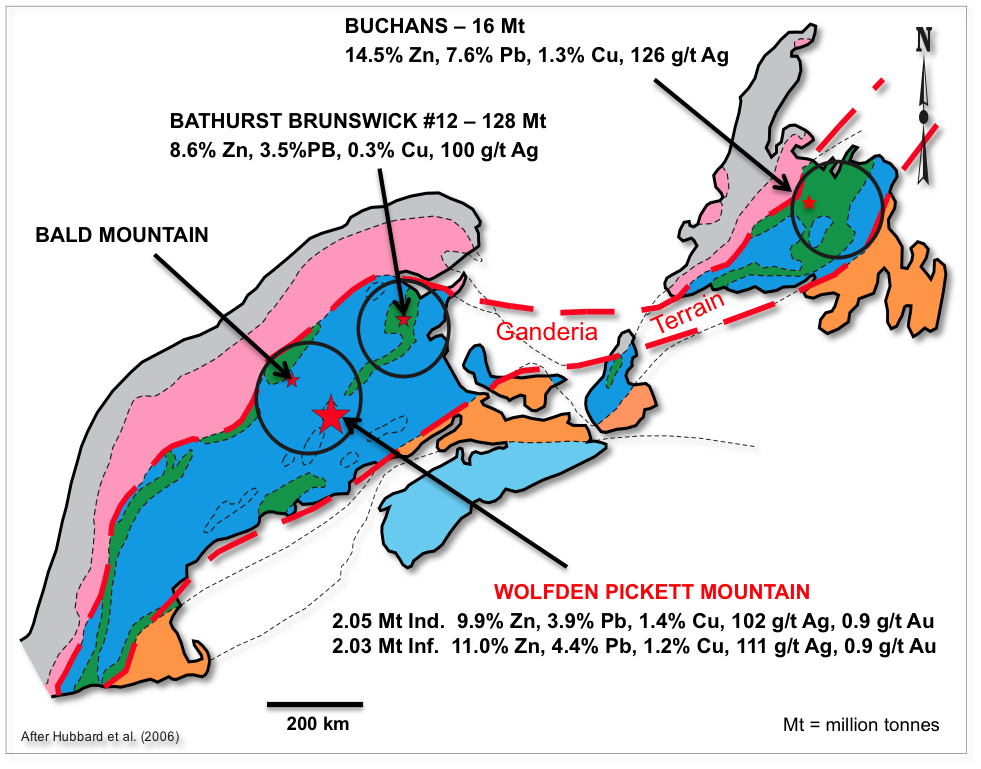
Geological map of the District
(Click image for larger view)
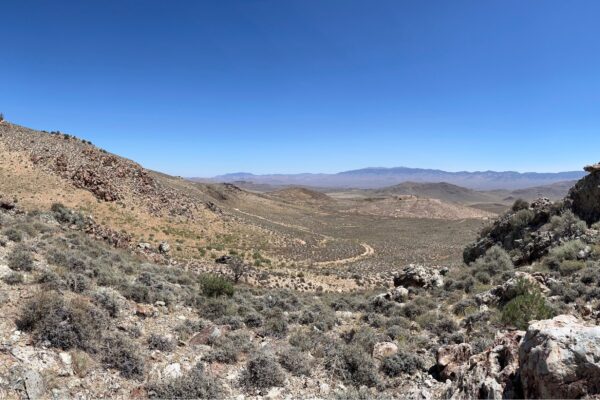
Property gallery
Location, Land Tenure & History
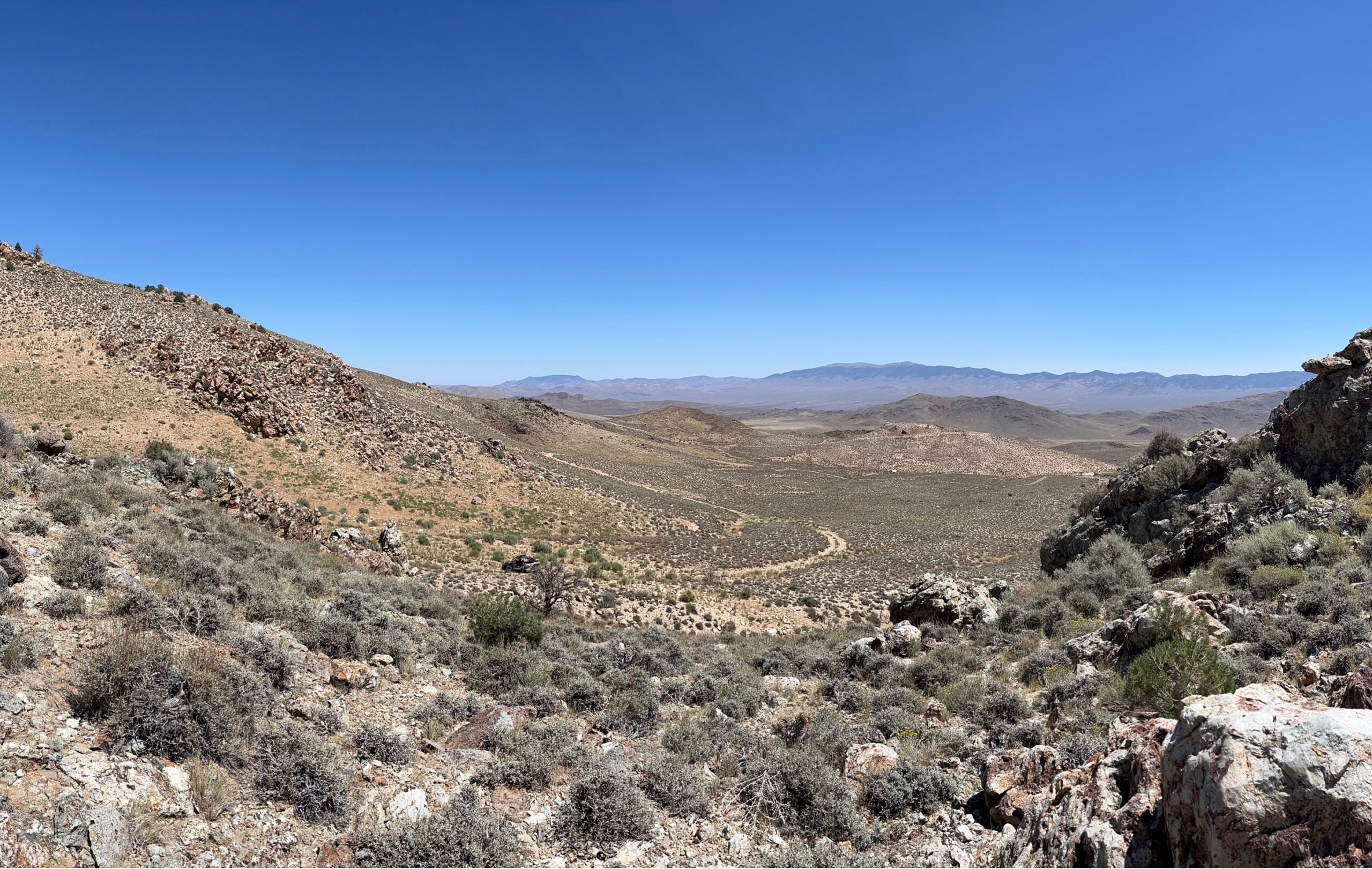
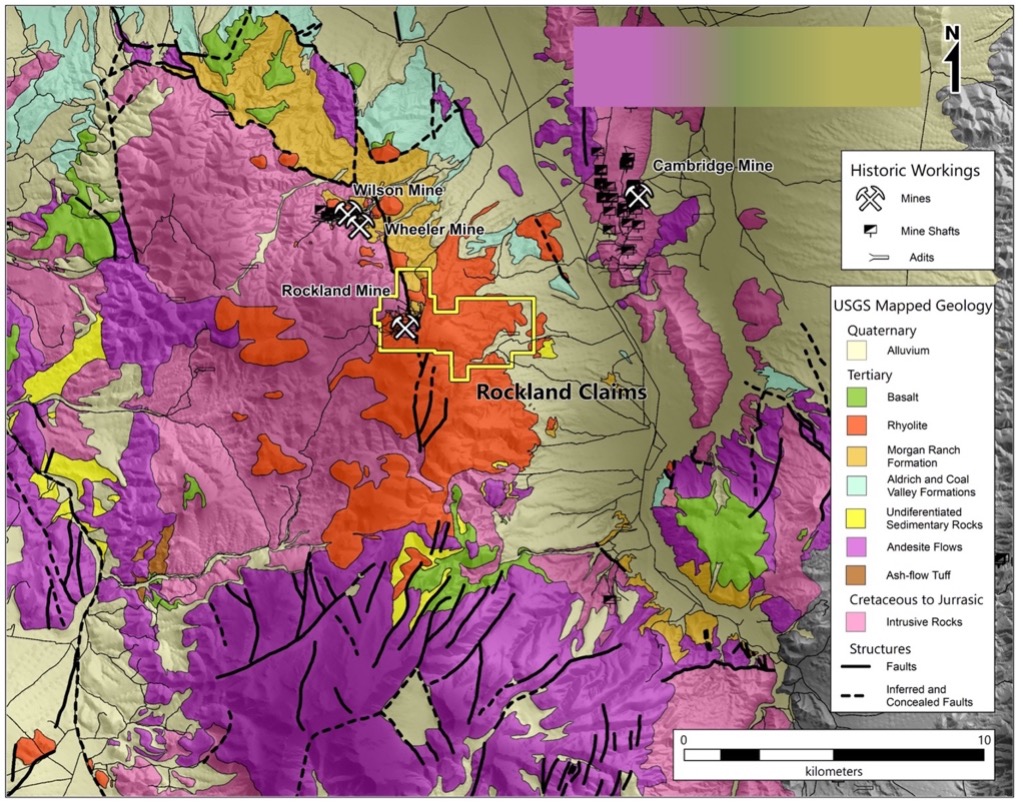
The Rockland property is located approximately 40 km (23 miles) south of the town of Yerington, in Lyon County, Nevada. The property consists of 127 unpatented lode mining claims located in (un-surveyed) sections 8,9,10,11,14,15,16,17,21 and 22, within T9N, R26E, MDBM. Wolfden has the right to acquire a 75% interest in the property via a lease agreement with Evergold Resources with the permission of the underlying claim owner Enigma Resources. The property is located in the southern portion of the historic Pine Grove mining district.
Total historical district gold production is estimated at 290,000 oz. gold (equivalent) from three primary mines at typical grades of >1 oz/t gold. The historic Rockland mine, which lies within the western portion of the property, has produced an estimated 50,000 ozs. of gold from banded epithermal veins, which are genetically related to a Tertiary rhyolite flow/dome complex.
Two types of gold deposits are present in the Pine Grove district: 1) porphyry/intrusion-related mesothermal quartz-sulfide veins; and 2) rhyolite dome-related, low sulfidation epithermal quartz veins and associated higher-grade stockwork and sulfidized breccia zones (Rockland mine). Of primary interest to Wolfden is the potential for deeper, high-grade, low sulfidation veins analogous to the Rockland mine. The strong association of gold mineralization with shallow rhyolitic domes suggests comparisons to the Sleeper and Midas Mines in Nevada, and the El Penon district, Chile.
Modern exploration has been carried out since 1988 by eight different companies comprising 15,340.7 m (50,330.38’) of drilling in 82 holes along with geological mapping, prospecting, ground geophysics (magnetic, IP and CSAMT), airborne drone magnetic, Aster alteration mapping and hyperspectral imaging of drill chips. Drilling highlights include an open-ended drill intercept at Rockland East of 0.84 g/t Au and 6.2 g/t Ag or 0.99 g/t AuEq over 146.4 m and a drill intercept of 0.95 g/t Au over 50.3 m at Rockland West.
(Click image for larger view)
(Click image for larger view)
(Click image for larger view)
Geology, Mineralization, 2025 Drill Program Plan
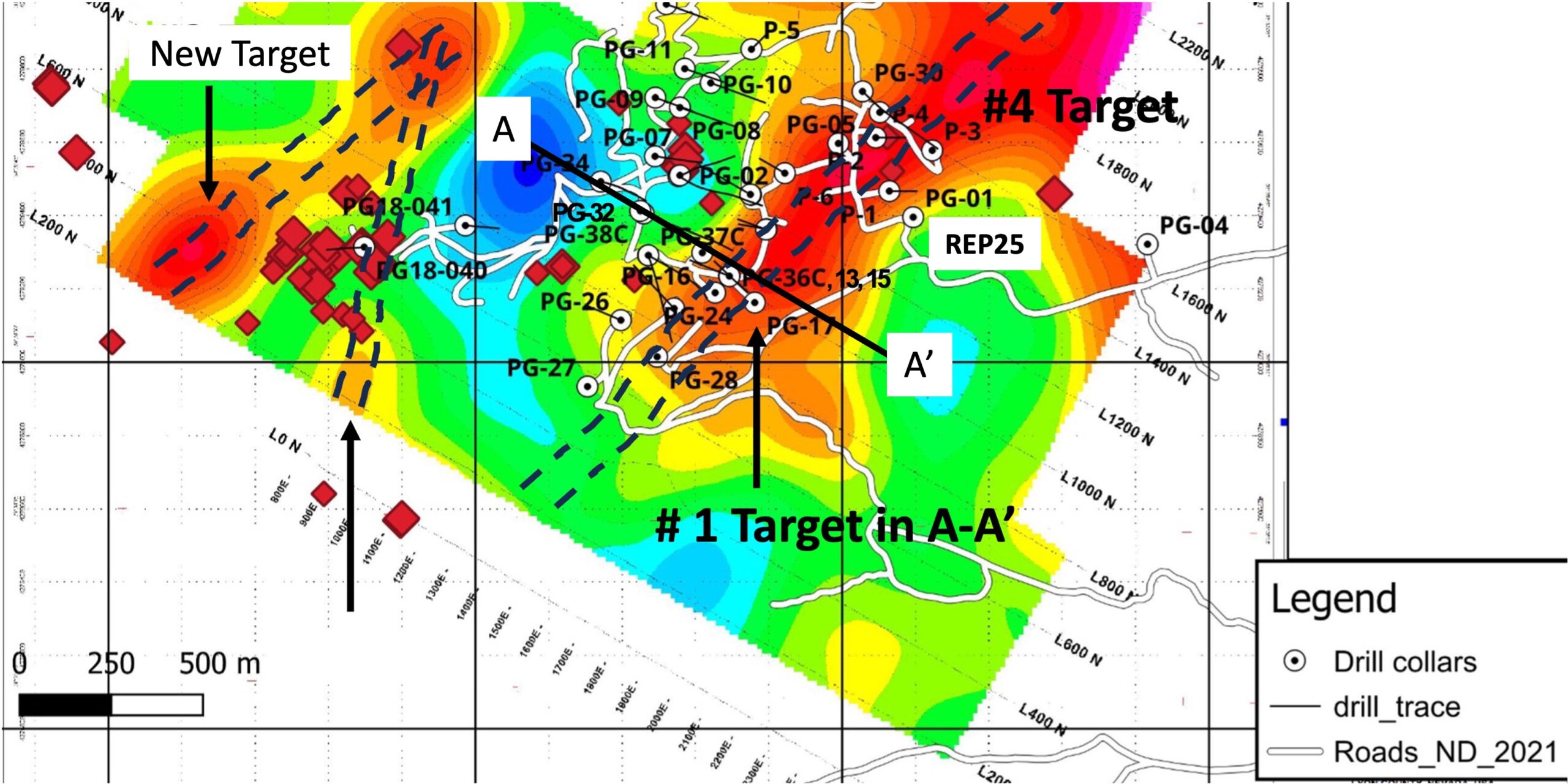
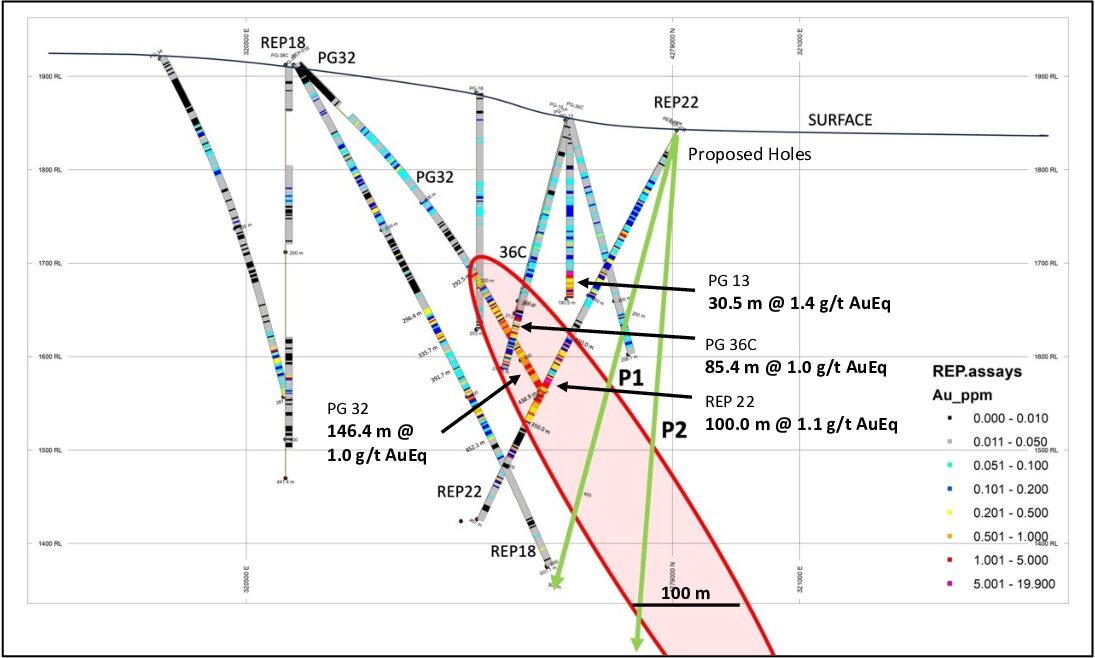
Drilling is planned to test the down-dip extension of hole PG-32, that returned 146.4 metres grading 1.0 g/t AuEq (see Figures 2 and 4). The hole PG-32 intercept lies along the northern edge of an 800 metre long, steep west-dipping CSAMT anomaly (Controlled-Source Audio-frequency Magnetotelluric) which is interpreted to represent a northeast-trending structure, an area of increased felsic volcanism and intrusions, and an area where hydrothermal fluids upwelled into structural and stratigraphic targets. This interpretation is supported, in part, by a hyperspectral scan of rock chips from hole PG-32, which indicated an increase in potassium illite content, corresponding with higher temperature alteration, to the end of the hole. It is believed that hole PG-32 was drilled just above a bonanza-type gold system or may have been stopped too soon. The first hole will be drilled from west to east to intersect the interpreted mineralized system approximately 75 metres below hole PG-32. Depending on results and validation of the orientation of the mineralized system, another hole may be drilled to test the target area from east to west. This follow-up hole could also determine if the interpreted mineralized system extends upward, closer to surface.
A second hole is proposed to test a large CSAMT anomaly below an area of outcropping epithermal quartz-adularia veins that returned elevated antimony, arsenic and gold (see Figures 2 and 5 for the section location and proposed drill section). This anomaly has never been tested and is interpreted as a potential area where gold-enriched hydrothermal fluids ponded both within, along side and below silicified rhyolites. This large target area lies near the intersection of northerly and northeast-trending CSAMT high resistivity structures.
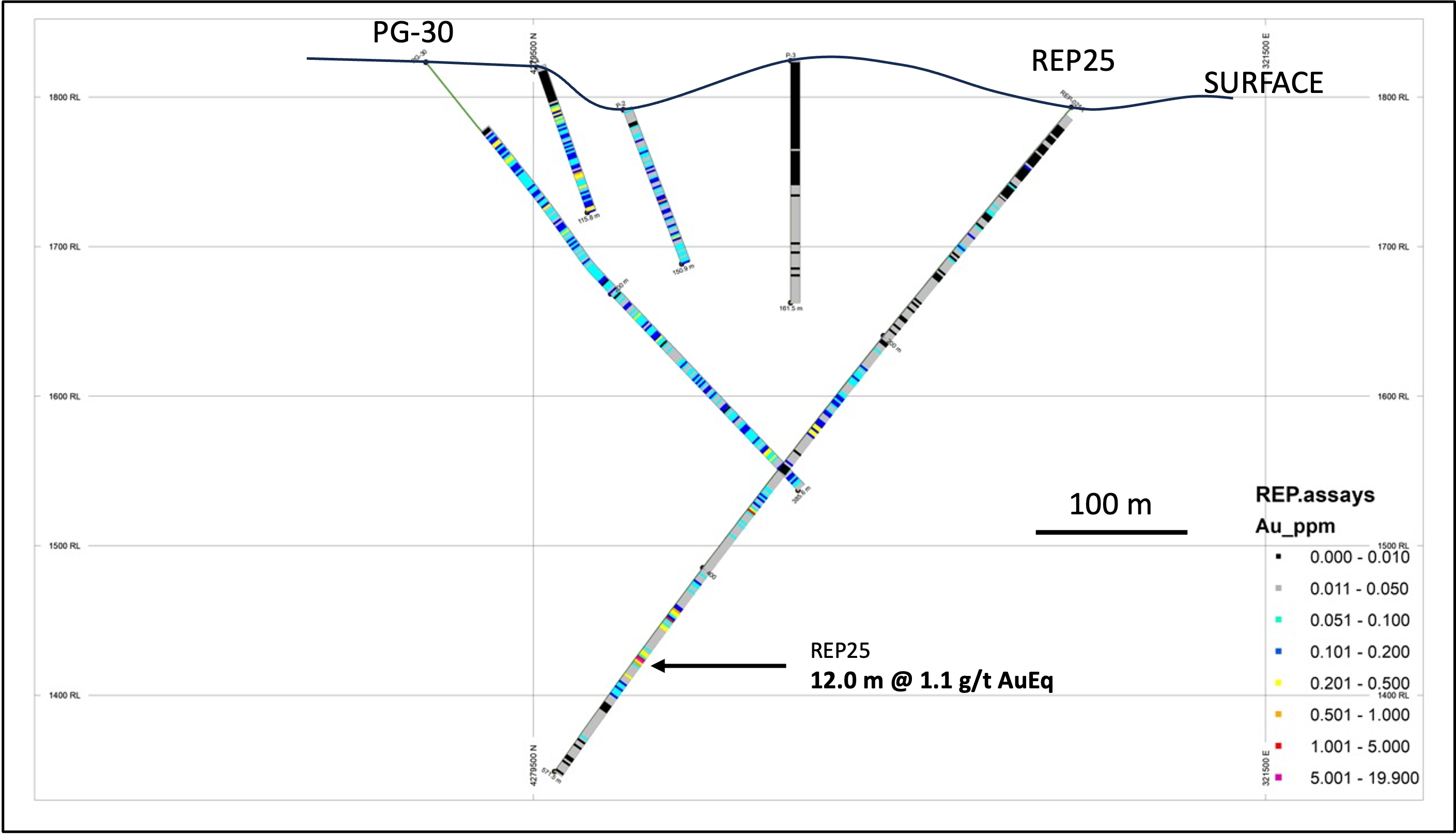
A third oriented core hole is proposed to test the base of the CSAMT resistivity high in an area of numerous epithermal quartz veins, an intersection area of quartz vein trends, an induced polarization (“IP”) chargeability anomaly and below hole, PG-30 (Figures 2 and 6 – Target Hill), which intersected 315 metres of anomalous (0.09 g/t average) gold mineralization from surface.
The overall size of the Rockland target area also compares favorably with that of AngloGold Ashanti’s Silicon-Merlin deposit area(see Figure 3). Rockland comprises a large area of hydrothermal alteration cut by numerous quartz-adularia veins that display low to bonanza-type gold grades along with enriched silver, arsenic and antimony levels, that warrants additional drilling.
The Rockland East target represents one of the most exciting drill ready exploration targets in the Walker Lane Trend as it consists of 1) gold intercepts that returned up to 1.0 g/t AuEq* over 146.4 metres that ended in mineralization, 2) an historic bonanza-type Au-Ag mine is part of the property package, 3) multi-square kilometre scale, argillic to advanced argillic, rhyolite and basin-margin-debris-hosted alteration zones that are cut by quartz veins enriched in antimony, arsenic and gold, and 4) geophysical data that suggests zones and structures where hydrothermal fluids upwelled and subsequently ponded, creating wide, lower grade gold zones that are interpreted to flank high-grade bonanza-type gold grades at depth. These are the typical characteristics exhibited by some of the high quality gold deposits in the Walker Lane Trend.
Preliminary metallurgical results
As part of Wolfden’s due diligence on Rockland, four rock and core assay reject (non-oxidized) samples containing from 1.0 g/t Au to 10.4 g/t Au were subjected to a 24-hr bottle roll cyanide leach using Leachwell as a catalyst; resulted in gold recoveries ranging from 85% to 98% and suggest the potential for good conventional gold recoveries.
Rockland Vertical Cross Section of A-A’
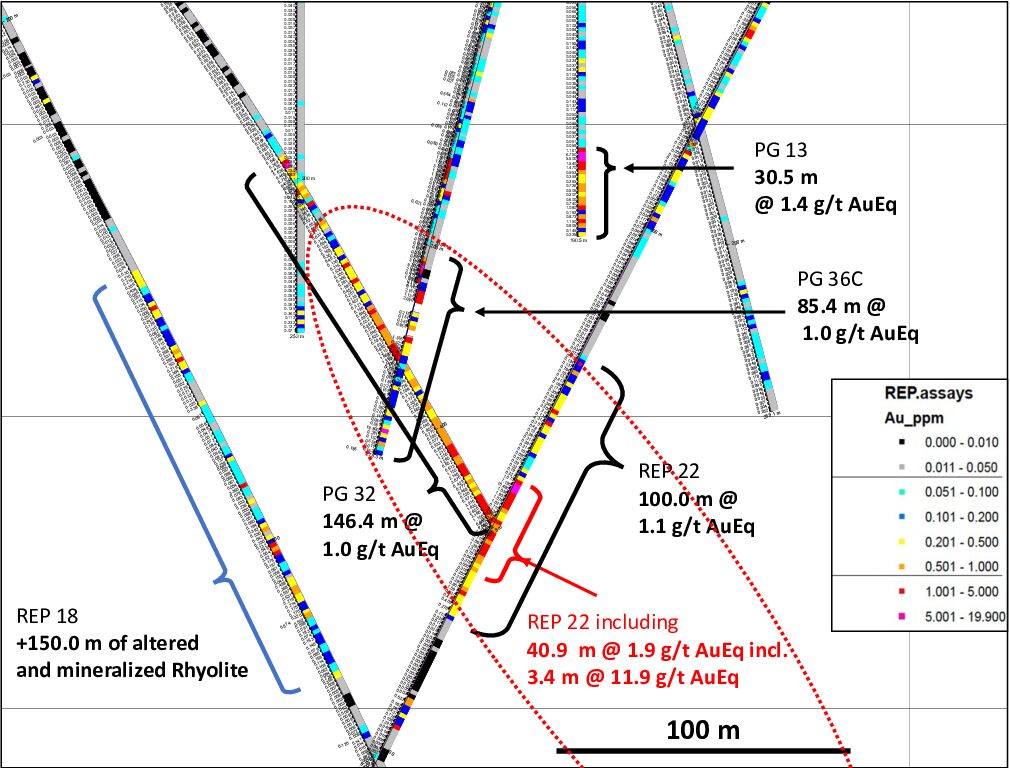
Rockland Vertical Cross Section of Target Hill (#4)